


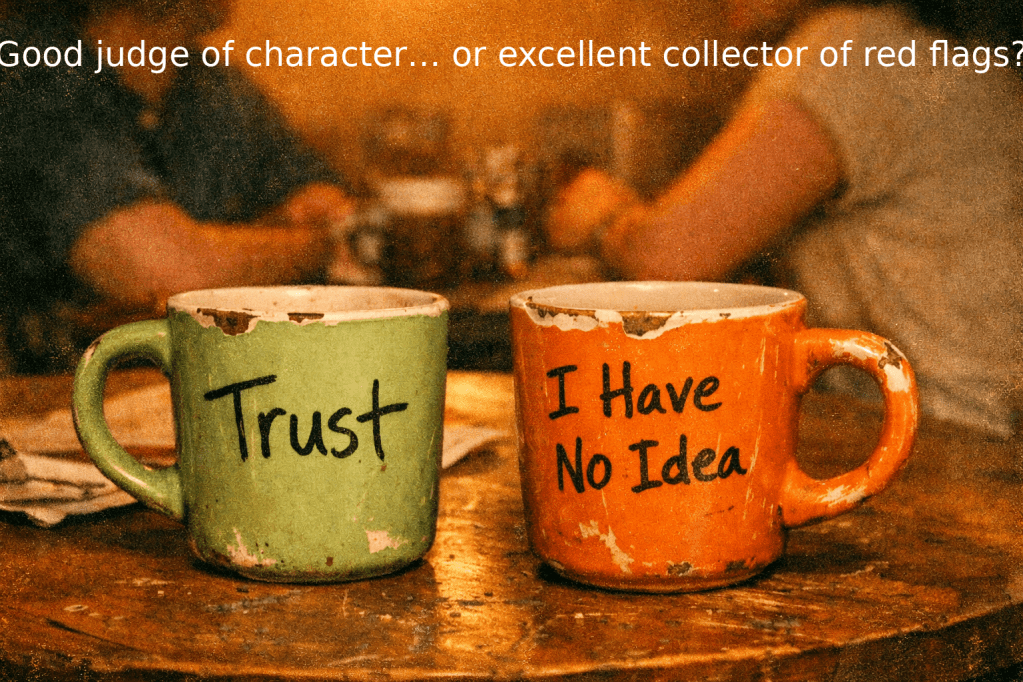
Mental health professionals love to pretend we have this secret superpower: we look at someone, tilt our head, and whisper, “that one’s trouble.” Then six months later we’re sitting on the floor eating ice cream thinking, I really didn’t see that coming.
If you’ve ever sworn you had great instincts, only to be proven wrong by a friend, lover, coworker, or that one parent at school who “seemed lovely”….
…Welcome to the club. The whole world lives here.
We Don’t Judge Character. We Judge Familiarity.
Most of us think we’re reading someone’s moral quality. We’re not. We’re reading how they make us feel. If someone feels safe, if they remind us of home, if they talk the way we talk or laugh at the same jokes, we decide they’re “good.” (and that’s something most mental health counsellors know and do during our sessions.)
Ever met someone you trusted within ten minutes? Felt like you’d known them forever? Later, of course, you learn they weren’t what you imagined. Did your intuition betray you? Not really. You just filled in the blanks with hope.
Why It’s Hard
People don’t walk around labeled “kind,” “selfish,” “honest,” “chaotic.” Life would be easier if they did. Instead, you meet someone on a good day and assume every day will look like that.
You see someone being polite to you and forget to check how they treat the waiter. You see someone buying flowers and forget to ask who they’re apologizing to. You see someone smiling and never wonder what sits under that smile.
We judge the movie trailer, not the full film.
The Bias Nobody Talks About
We trust the people who give us something we crave.
Validation. Attention. Safety. Belonging.
If you grew up with chaos, calm feels suspicious. If you grew up unseen, attention feels magical.
So when people ask, “Why didn’t you see it?”
The real answer is:
because your heart was busy hoping.
What Makes Someone a Truly Good Judge of Character
Not psychic instinct. Not instant impressions. Not charm radars.
It’s time.
It’s watching patterns.
It’s noticing how someone behaves when they’re:
tired, angry, disappointed, embarrassed, or told “no.”
And most of all:
it’s being willing to change your mind about a person, even when you love them.
Sometimes we see people clearly—we just don’t want the picture we’re seeing. We overlook comments because we don’t want conflict. We ignore our gut because we want connection.
We rationalize “bad days” because we want the story to end differently.
That doesn’t mean you’re bad at reading people. It means you care.
So… Are You a Good Judge of Character?
Probably better than you think, just not in the dramatic movie-trailer way. Maybe you don’t get it right at the beginning. Maybe you need time to process. Maybe you trust too deeply or forgive too easily.
But knowing who someone is doesn’t happen at first sight.
It happens after the first disappointment.
The first boundary.
The first moment when your needs clash with theirs.
If they show kindness where ego could have won?
That’s character.
If they stay accountable when nobody is watching?
That’s character.
If they treat you with care even after the honeymoon stage?
That’s character.
With One Final Breath
You don’t have to be perfect at judging people. You just have to be willing to learn without hating yourself for the learning.
Every person you misjudged taught you something about your own needs and wounds. Every person you chose right restored something inside you.
And maybe the real question isn’t “Am I good at judging character?”
But:
“Am I becoming someone whose own character I’m proud of?”
That’s the judgment that actually matters… cause at the end of the day, you are born alone and you die alone, and your character shapes what happens in between.


 Sonia M. Rompoti, MSc, Bsc
Leave a comment