



“Thinking, Fast and Slow” is a tour de force that brings to light the intricate machinery of the human mind, as explored by Nobel laureate Daniel Kahneman.
At its core, the book delves into the two systems that drive our thoughts: System 1, intuitive and quick; and System 2, logical but slower. Kahneman’s engaging narrative takes us on a journey through the biases and heuristics that influence our decisions, often without our conscious awareness.
The Dual-Process Model: System 1 and System 2
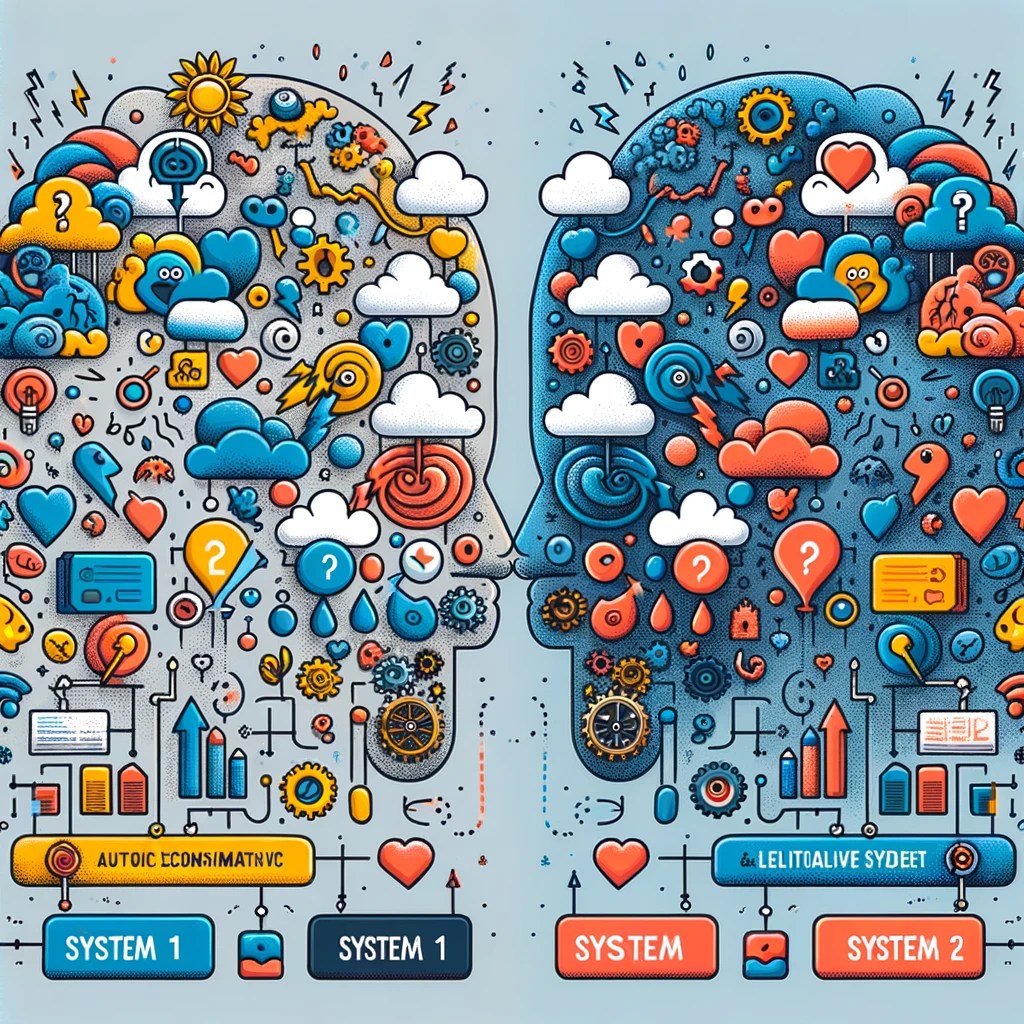
Kahneman introduces readers to the dual processes that govern our thinking.
System 1 operates automatically and quickly, with little or no effort and no sense of voluntary control. In contrast, System 2 allocates attention to the effortful mental activities that demand it, including complex computations.
The book is filled with compelling examples and experiments that illustrate how these two systems interact and the dominance of System 1 in our everyday decision-making.

Heuristics and Biases
One of the book’s significant contributions is its detailed examination of the various heuristics (mental shortcuts) and biases that affect our thinking.
Kahneman discusses how these patterns of thought can lead to systematic errors in decision-making. For instance, he explores the availability heuristic, where people judge the probability of events based on how easily examples come to mind, and the anchoring effect, where initial exposure to a number shapes subsequent judgments.
Implications for Decision Making
Kahneman’s insights have profound implications for understanding human behavior and decision-making. By recognizing the influence of System 1, individuals and organizations can better guard against potential biases and errors. Kahneman also offers strategies for engaging System 2 more effectively to improve judgment and decision-making processes.
Impact and Critique
“Thinking, Fast and Slow” has had a considerable impact across various fields, from economics and psychology to business and public policy. However, it has not been without its critics.
Some have argued that the book overstates the frequency and impact of cognitive biases in decision-making, while others have raised questions about the replicability of some of the research findings Kahneman presents.
Practical Applications
Kahneman’s work offers valuable insights into how decisions are made in the real world. For instance, understanding the overconfidence bias can help investors make more rational financial choices. Similarly, recognizing the impact of loss aversion can aid policymakers in designing better public health interventions.
Here are a few steps you can take to deepen your engagement with the book’s themes and apply its insights:
- Self-Reflection: Spend a week observing your decision-making processes. Note instances where you suspect System 1 is at play. Reflect on how these automatic judgments shape your decisions and consider moments when engaging System 2 might lead to a better outcome.
- Discussion Group: Join or initiate conversations within your book club or online communities dedicated to psychology, behavioral economics, or even general self-improvement. Sharing insights and personal experiences can enrich your understanding and application of Kahneman’s work.
- Practical Application: Choose one insight from the book—be it the understanding of a specific bias, the heuristics concept, or the System 1/System 2 dichotomy—and consciously apply it to a decision-making process in your personal or professional life. This could involve reassessing how you make financial decisions, reevaluating habits, or simply being more mindful of your thought processes.
- Further Reading: Kahneman’s book opens the door to a vast field of research on decision-making and cognitive biases. Expand your exploration by reading related works from other authors in the field, such as Richard Thaler, Cass Sunstein, and Amos Tversky, to gain a broader perspective on behavioral economics and psychology.
- Engage with the Community: Participate in workshops, webinars, or online courses that focus on improving decision-making skills, critical thinking, or understanding cognitive biases. Engaging with a community of learners can provide new insights and practical strategies for applying Kahneman’s theories.
Your Turn to Think Slow: As you move forward, challenge yourself to engage System 2 more actively in your daily life. Whether it’s pausing to analyze your reactions, questioning your initial judgments, or simply being more mindful of the thought processes behind your decisions, each step is a move towards more informed, deliberate, and rational decision-making.
By actively engaging with the concepts presented in “Thinking, Fast and Slow,” we can strive to become better thinkers, decision-makers, and navigators of the complex world around us.
Let this be the start of a deeper journey into understanding ourselves and improving how we interact with the world. Join the conversation, apply the insights, and witness the transformative power of informed and thoughtful decision-making in your life.



 Sonia M. Rompoti, MSc, Bsc
Leave a comment