


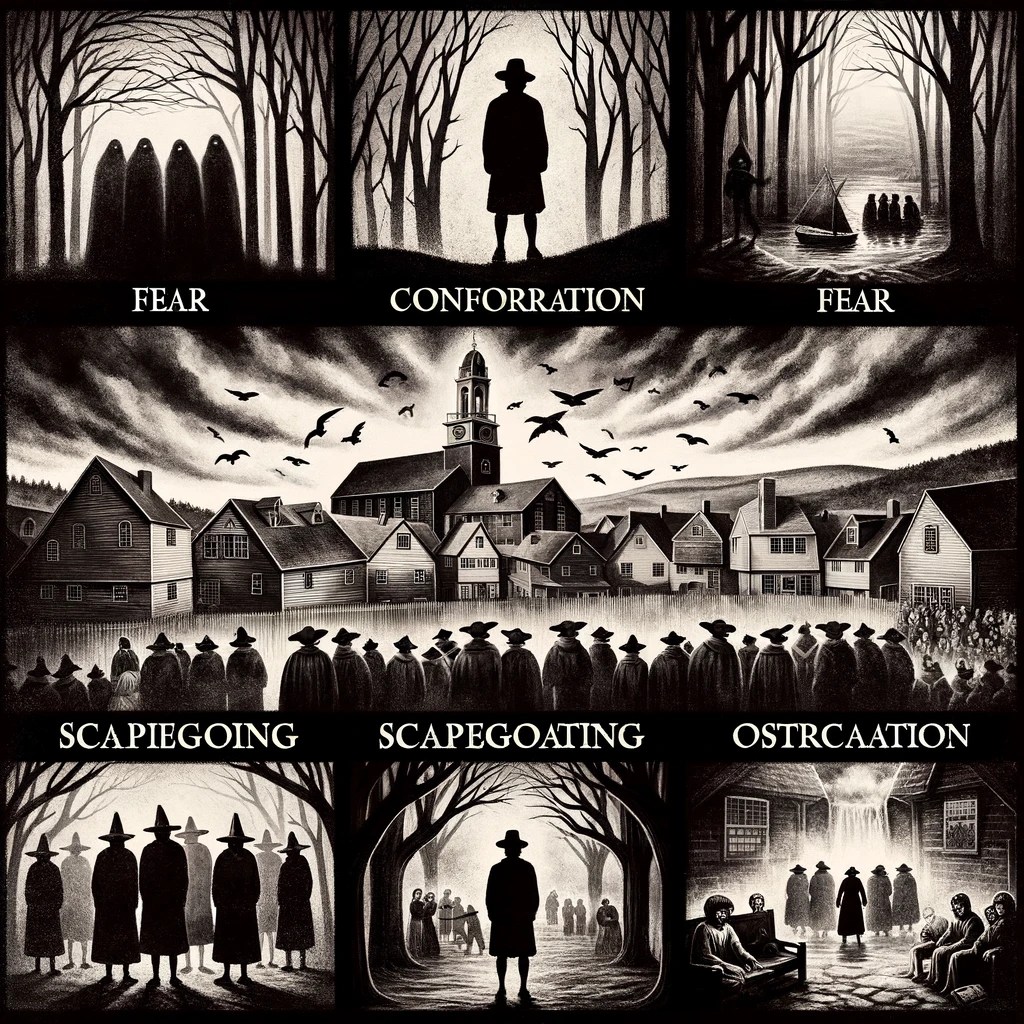
Witch trials, such as the infamous Salem witch trials of 1692, offer a rich historical case study for understanding the complex interplay of social psychological phenomena, including fear, conformity, scapegoating, mass hysteria, and the ostracization of the “other.”
By analyzing these events through the lens of social psychology, we can gain insights into the mechanisms that drive similar patterns of behavior in contemporary society.
This article aims to explore these themes, drawing upon specific events from history to illuminate the psychological underpinnings of these trials and reflect on the implications for current societal dynamics.
Fear and Mass Hysteria
Fear is a powerful motivator of human behavior, often leading to irrational and destructive actions. In the context of the witch trials, fear was multifaceted: fear of the unknown, fear of the “other,” and fear for personal safety amidst a perceived threat of witchcraft. This fear was often amplified by uncertain social, political, and economic conditions, creating a fertile ground for mass hysteria.
Mass hysteria, or collective panic, occurs when fear spreads uncontrollably through a population, leading individuals to abandon rational thought and engage in hysterical behavior.
The Salem witch trials are a prime example, where accusations of witchcraft quickly spiraled into a community-wide panic, resulting in the wrongful conviction and execution of many individuals.

Conformity and Social Pressure
Conformity, the act of matching attitudes, beliefs, and behaviors to group norms, played a significant role in the propagation of witch trials.
In tight-knit communities, the pressure to conform to the dominant narrative of witchcraft accusations was immense. Individuals who dared to question the legitimacy of the trials or defend the accused risked becoming social pariahs or, worse, being accused of witchcraft themselves.
This phenomenon is illustrative of the Asch conformity experiments, which demonstrated the power of social pressure in influencing individuals to conform to the group, even against their own judgment.

Scapegoat Theory
Scapegoating, the practice of blaming an individual or group for problems that they did not cause, is another social psychological principle that underpins the witch trials. During times of social unrest or collective anxiety, communities often seek a tangible source for their misfortunes.
In the case of the witch trials, those accused of witchcraft—often women, the elderly, or social outcasts—served as convenient scapegoats for the community’s fears and frustrations. This practice not only diverted attention from the real issues at hand but also reinforced social cohesion by uniting the community against a common enemy.

The Ostracization of the “Other”
The witch trials were also marked by the ostracization of individuals who were perceived as different, whether due to their gender, age, social status, or religious practices.
This “othering” process is a key aspect of in-group/out-group dynamics, where the majority group defines its identity in opposition to an excluded minority. This dynamic facilitates the dehumanization of the out-group, making it easier for the in-group to justify persecution and violence.
The witch trials serve as a stark reminder of the dangers of othering and the capacity for dehumanization to lead to grave injustices.
Reflections on Contemporary Society
The psychological dynamics observed in historical witch trials are not confined to the past; they continue to manifest in various forms in contemporary society.
From the spread of conspiracy theories and fake news to the scapegoating of minority groups during times of crisis, the same social psychological mechanisms are at play.
Understanding the roots and mechanisms of these behaviors can help us recognize and counteract them in our own time, promoting a more rational, inclusive, and compassionate society.
Final Words
The witch trials offer a poignant example of how fear, conformity, scapegoating, mass hysteria, and the ostracization of the “other” can converge to fuel collective injustice.
By examining these events through the lens of social psychology, we not only gain a deeper understanding of human behavior but also equip ourselves with the knowledge to prevent the repetition of such tragedies.
It is through reflecting on our history and its psychological underpinnings that we can hope to forge a future that values reason, empathy, and justice above fear and prejudice.
This analysis provides a foundation for understanding the social psychological dynamics at play in historical witch trials and their relevance to contemporary societal issues. While the specific events and contexts may change, the underlying human behaviors and tendencies remain remarkably consistent, offering timeless lessons for navigating the complexities of social life.



 Sonia M. Rompoti, MSc, Bsc
Leave a comment